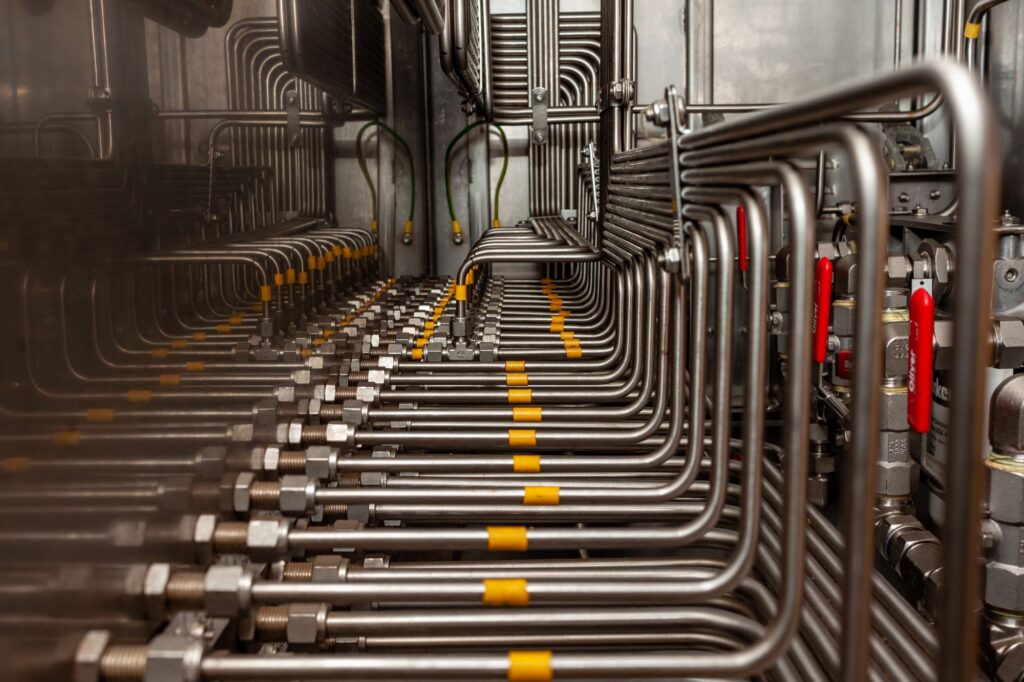
Stainless steel is commonly used in corrosion-sensitive tube and fabricated assembly applications such as automotive and commercial-vehicle fluid systems, thermal-management components, industrial equipment, aerospace support hardware, and selected food, chemical, and medical-device components. Its corrosion resistance comes from a chromium-rich passive surface, but final performance depends on the specific alloy, surface condition, joint design, brazing filler metal, and actual service environment.
For stainless-steel assemblies, Franklin Brazing uses controlled-atmosphere continuous belt furnaces and works with customers to develop a process appropriate to the material specification, joint design, filler metal, and production requirements.
Considerations in Stainless Steel Furnace Brazing
Oxidation and Wetting
Oxygen and moisture can interfere with braze-metal wetting and may affect surface appearance. A properly selected and controlled furnace atmosphere helps minimize oxidation and supports consistent brazing results.
Thermal Cycle and Sensitization
Some austenitic stainless steels can become susceptible to sensitization after certain time-and-temperature exposures. The risk depends on alloy chemistry—including carbon content and stabilization—section thickness, time at temperature, and cooling rate. Material selection and furnace profile should therefore be evaluated collaboratively by the customer and Franklin Brazing, particularly for corrosion-critical applications.
Flux-Free Processing
For assemblies compatible with controlled-atmosphere furnace brazing, a flux-free process can eliminate flux residue and the associated residue-removal operation. Any required post-braze cleaning, passivation, testing, or validation remains dependent on the customer’s material, application, specification, and regulatory requirements.
Controlled-Atmosphere Brazing for Stainless Steel Assemblies
Franklin Brazing uses hydrogen-nitrogen furnace atmospheres selected to support clean surfaces and consistent filler-metal flow for applicable assemblies. Atmosphere condition, furnace temperature profile, and belt speed are managed as part of the approved production process.
This approach is especially valuable for high-volume stainless tube assemblies where repeatability, joint integrity, appearance, and downstream manufacturing requirements matter. We work with customer engineering and quality teams to establish appropriate process requirements, inspection methods, and validation plans for corrosion-sensitive or otherwise critical applications.
Built for High-Volume, Print-Controlled Production
Running one acceptable part is not the same as producing thousands of parts consistently. Franklin Brazing’s continuous belt furnace process is designed for repeatable production of brazed assemblies using documented procedures and relevant process controls.
For each program, we work from the customer’s drawings, material and filler-metal requirements, inspection criteria, and approved production process. Where appropriate, we can support process development, production trials, and qualification planning before production launch.
Work With a Stainless Steel Brazing Partner
If you are looking for a manufacturing partner for stainless steel tube assemblies or fabricated components, Franklin Brazing can help evaluate material selection, joint design, furnace-brazing compatibility, and production requirements—and then produce the parts for you.
Contact Franklin Brazing today to discuss your stainless-steel brazing project.
Disclaimer: Brazing-process suitability, joint performance, corrosion resistance, cleaning/passivation needs, and final-component qualification depend on the specific material, joint design, filler metal, operating environment, and customer requirements. Franklin Brazing performs work to mutually agreed specifications and approved process requirements. Unless expressly agreed in writing, the customer is responsible for final application design, validation, regulatory compliance, and end-use environmental compatibility.