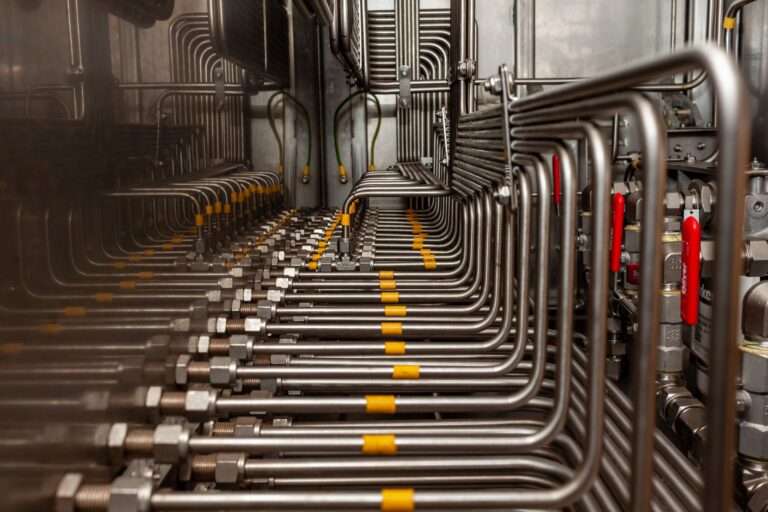
Commercial HVAC and refrigeration manufacturing demands high-volume production of complex copper and steel assemblies. Components like multi-port manifolds, distributor assemblies, and heat exchangers require dozens of reliable joints to operate under constant pressure and thermal cycling.
As production volumes scale, relying on traditional manual torch brazing stations often introduces operational bottlenecks. Transitioning to automated continuous mesh belt furnace brazing offers a scalable alternative, allowing manufacturers to increase throughput while stabilizing process control across high-volume product lines.
The Bottlenecks of Manual Torch Brazing
Manual hand-torch brazing is a highly localized, operator-dependent process. While effective for low-volume runs or unique geometries, it introduces distinct challenges when scaling to meet commercial demand:
Joint-by-Joint Variability
Human operators must control torch distance, angle, and heating time for every single joint. This variation can lead to inconsistent filler metal penetration and localized overheating.
Labor Constraints
Finding, training, and retaining skilled braze technicians is an ongoing operational hurdle that risks capping a facility’s total manufacturing capacity.
Secondary Post-Braze Cleaning
Manual processes typically utilize aggressive chemical fluxes to prevent oxidation. This flux leaves behind a corrosive residue that requires an additional, labor-intensive acid washing or manual scrubbing step.
The Continuous Furnace Advantage
Controlled atmosphere continuous mesh belt furnaces remove the variability of hand-brazing by automating the thermal cycle. Rather than heating one joint at a time, assemblies move dynamically through precise heating zones, offering specific advantages for HVAC/R components:
Simultaneous Multi-Joint Processing
A typical HVAC distributor or manifold assembly can feature dozens of individual tube-to-fitting joints. In a continuous furnace, the entire assembly is heated uniformly. This allows every joint on the part to be bonded simultaneously in a single cycle, drastically increasing throughput compared to sequential manual methods.
Process Cleanliness Without Flux
Operating with a protective controlled atmosphere prevents surface oxidation naturally during the heating cycle. Because the process runs entirely without chemical fluxes, the assemblies emerge from the furnace bright, clean, and completely dry. This eliminates the need for post-braze washing, allowing components to move immediately to the next stage of assembly or pressure testing.
Greater Capacity and Throughput
Continuous furnace brazing is built for volume. Unlike torch brazing, which processes joints or assemblies individually, a mesh belt furnace moves parts continuously through the brazing cycle. This creates substantially greater throughput and production capacity, helping reduce labor intensity, improve efficiency, and deliver more consistent value at scale.
Stabilizing the Supply Chain for Procurement
For procurement and operations managers, outsourcing to an automated brazing partner is a strategic move to secure lead times and de-risk the assembly process. Controlled atmosphere belt brazing provides the high repeatability needed to satisfy strict industry quality requirements and customer-designed prints.
By stabilizing process variables—such as belt speed, gas flow, and temperature curves—manufacturers can expect a highly consistent output from the first part to the last. This predictable manufacturing environment minimizes scrap rates, protects delivery timelines, and supports the overall economics of high-volume HVAC production.
Your Partner for High-Volume HVAC Brazing
Franklin Brazing delivers the automated capacity and technical expertise required to support demanding commercial HVAC and refrigeration supply chains. Our continuous mesh belt furnaces are optimized to handle complex multi-joint copper and steel assemblies efficiently. We work closely with your engineering team to align our furnace capabilities with your exact dimensional specifications and volume targets.
Contact Franklin Brazing today to discuss your HVAC component project and discover how our automated continuous belt processing can support your production goals.
Disclaimer: Brazing process suitability, joint performance, and final component qualification depend on customer application-specific design, materials, operating conditions, and customer validation requirements. Final component qualification and airworthiness approval remain the responsibility of the customer and applicable regulatory authorities.