In manufacturing, not every process needs to be brought in-house.
Some operations are core to your competitive advantage. Others require specialized equipment, controlled environments, and process discipline, all of which are difficult to replicate.
Brazing often falls into that second category.
The question is not simply, “Can I braze this component?” The question is, “Can I braze this component consistently, at scale, with repeatable results?”
When performance, sealing integrity, and dimensional stability matter, a strategic brazing partnership should become part of your overall production strategy.
When Brazing Becomes a Production Variable
In the early development stages, brazing could be handled internally for prototype runs. But as programs mature, the demands change.
Volume Increases
What begins as limited production can scale fast. Internal setups that work for occasional assemblies may not support sustained throughput.
Quality Requirements Tighten
As assemblies move into regulated or mission-critical industries, documentation and repeatability become essential. Brazing is no longer treated as a general fabrication step; it has to be executed as a controlled metallurgical process with verified temperature profiles, atmosphere management, and repeatable joint performance.
Variability Becomes Risk
Without controlled atmosphere conditions, accurate furnace profiling, and disciplined fixturing, joint performance can vary. In structural or fluid-transfer assemblies, that variability directly impacts reliability.
Signs You May Need a Dedicated Brazing Partner
Certain conditions signal that outsourcing may be the more stable long-term solution.
Controlled Atmosphere is Required
Oxidation control and alloy wetting behavior depend on atmosphere management. Inconsistent environments compromise joint integrity.
Multiple Joints Must Be Formed Simultaneously
Complex assemblies require uniform heating and precise thermal control. Production-grade furnaces are designed for this consistency.
Dimensional Stability is Critical
If distortion affects downstream assembly, sealing, or alignment, thermal precision becomes non-negotiable.
High-Volume Repeatability is Needed
Production programs depend on consistency across batches and over time. If output fluctuates, performance becomes unpredictable.
When brazing becomes tied to product reliability, infrastructure matters.
What a Production-Scale Brazing Partner Provides
There is a meaningful difference between performing brazing and engineering a repeatable brazing process.
A dedicated partner offers:
- Controlled atmosphere furnace systems
- Documented and repeatable thermal cycles
- Structured production scheduling
- Traceability and quality oversight
- Scalable throughput capacity
This level of process control reduces variability and supports long-term manufacturing stability.
Franklin Brazing: 50+ Years of Experience
At Franklin Brazing & Metal Treating, we’ve specialized in controlled-atmosphere and continuous-belt brazing since 1973.
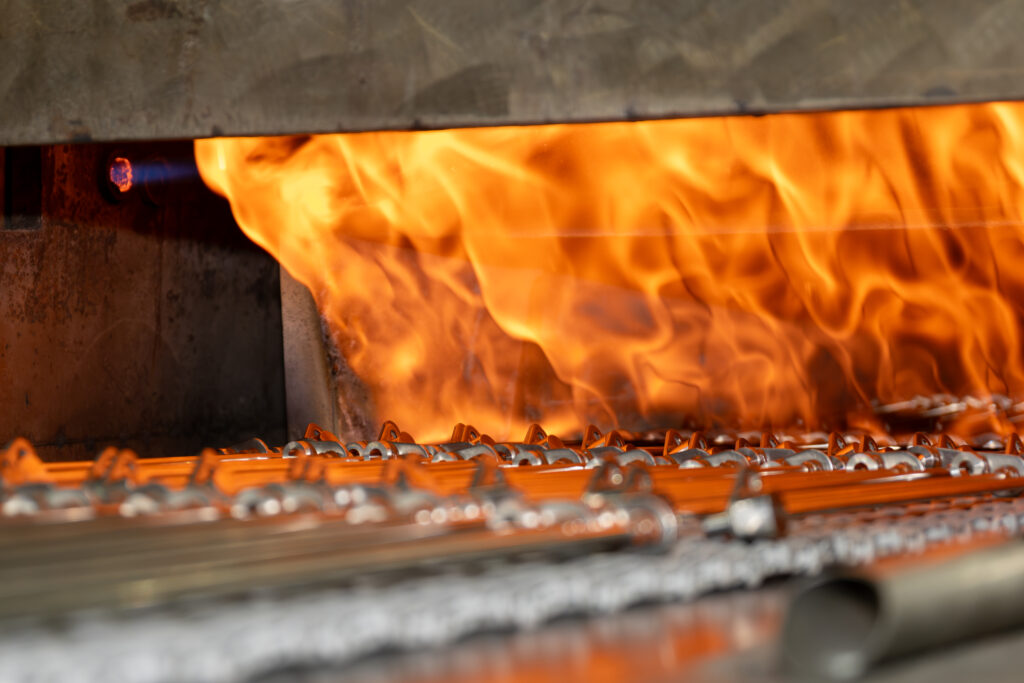
Our 50,000+ sq ft facility in Lebanon, Ohio, operates three shifts and is built specifically for repeatable, production-grade thermal processing. We focus on stainless steel and carbon steel assemblies requiring consistent metallurgical performance.
We do not perform vacuum brazing. Our strength lies in controlled-atmosphere continuous-belt systems designed for scalable throughput and predictable results.
We partner with manufacturers who need:
- Process discipline rather than experimentation
- Dimensional consistency across production runs
- Stable scheduling and long-term program support
- Documented, repeatable thermal control
We operate as an extension of your manufacturing process.
When Keeping Brazing In-House Makes Sense
There are scenarios where internal brazing is the practical solution:
- Low-volume assemblies
- Non-critical components
- Early-stage prototyping
- Applications with limited performance risk
This decision is about capability, but a major aspect of it is risk management and production stability.
So, Do You Need a Brazing Partner?
If your assemblies require:
- Robust braze joints
- Dimensional accuracy
- Thermal consistency
- High-volume repeatability
- Consistent quality
Then brazing is not simply a joining step. It’s a controlled process that directly influences product performance. When that process becomes critical to uptime, safety, or durability, partnering often becomes the strategic choice. The right brazing partner will not replace your manufacturing capability—it will strengthen it.