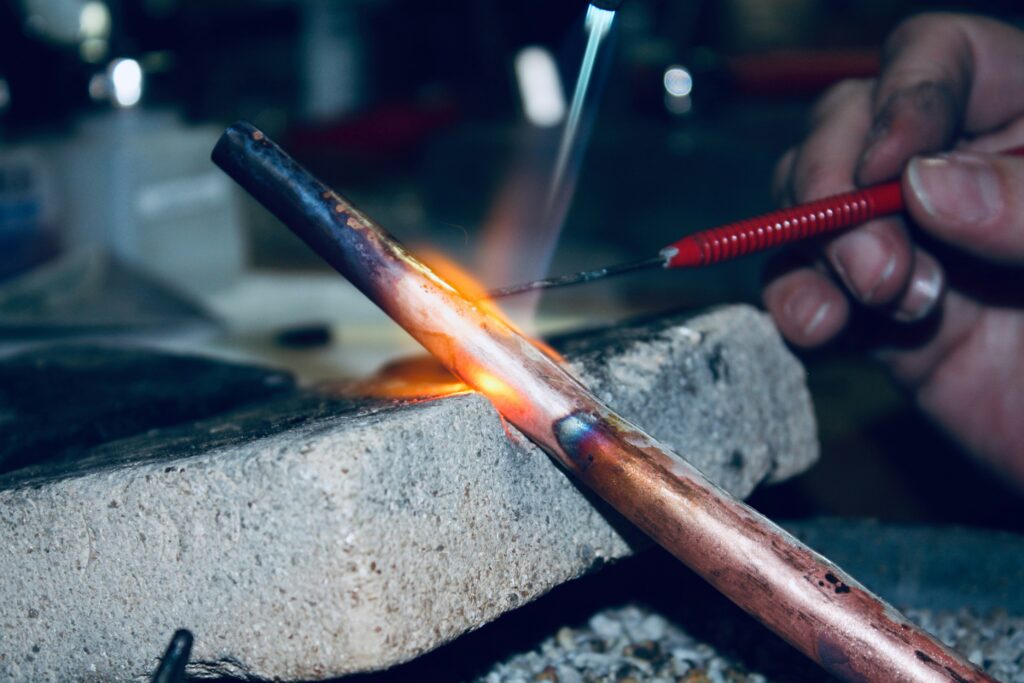
Joining two identical pieces of metal is a standard manufacturing task. However, the complexity increases significantly when an assembly requires joining two entirely different materials. In these scenarios, the challenge isn’t just about the bond itself; it is about managing the physics of how those metals behave under intense heat.
The primary obstacle in joining dissimilar metals is the Coefficient of Thermal Expansion (CTE). Every metal expands and contracts at a different rate. If these forces are not properly accounted for in the design and process, the resulting joint may crack, warp, or fail prematurely during the cooling cycle.
Understanding the CTE Challenge
When you place an assembly into a furnace, the materials grow at different speeds. This mismatch creates internal stress that can lead to two specific failure points:
High-Expansion Metal on the Outside
If the faster-expanding metal (like copper) is the outer component, the gap between the two pieces will widen as the temperature rises. This can result in a joint clearance that is too large for capillary action to occur, leading to a weak or incomplete bond.
High Expansion Metal on the inside
Conversely, if the faster-expanding metal is on the interior, it can expand so much that it eliminates the joint clearance entirely. This “crushes” the filler metal or prevents it from flowing into the joint at all.
Common Dissimilar Metal Pairings
To support high-performance assemblies, engineers often mix materials to leverage the specific benefits of each.
Copper to Stainless Steel
Frequently seen in cooling plates and heat exchangers, this pairing combines the thermal conductivity of copper with the structural strength of stainless. The CTE mismatch here is significant and requires precise clearance calculations.
Nickel Alloys to Carbon Steel
Used in high-temperature industrial applications, this combination requires a filler metal that can wet both surfaces effectively without creating brittle phases.
Aluminum to Specialty Alloys
In lightweight structural components, aluminum is often joined to other alloys to provide specific mounting points or wear resistance. This requires a very narrow and highly controlled temperature window.
Designing for the "Hot Clearance"
In standard brazing, engineers design for “room temperature clearance,” which is the gap between parts before they enter the furnace. When working with dissimilar metals, we must instead design for “hot clearance.” This is the actual gap that exists when the parts are at the brazing temperature.
Precision brazing requires calculating these shifts in advance. For example, when joining a high-expansion metal to a low-expansion metal, the initial fit-up might feel loose or excessively tight at room temperature. However, a knowledgeable brazing partner knows that once the furnace reaches 1200°F or 2000°F, those parts will move into the ideal position for capillary action to occur.
Metallurgical Compatibility and Filler Selection
Beyond the physical movement of the parts, there is the matter of chemistry. The filler metal must be able to “wet” both surfaces effectively without creating brittle intermetallic compounds.
For instance, brazing copper to stainless steel often requires silver-based filler metals. These fillers provide the ductility needed to absorb some of the residual stress caused by the CTE mismatch. In high-volume industrial manufacturing, selecting a filler that balances strength with flexibility is the key to long-term reliability in the field.
Why Consistency Matters at Scale
Managing these variables is possible in a lab setting, but maintaining that precision across thousands of parts requires a controlled process. This is why controlled atmosphere brazing is preferred for dissimilar metal assemblies. By maintaining a uniform heating rate throughout the furnace, we ensure that both metals reach their “hot clearance” state simultaneously. This repeatability reduces process variation and helps maintain consistent joint quality across production runs.
Solving Your Complexity Joining Challenges
At Franklin Brazing, we specialize in the technical nuances that other shops might overlook. We don’t just run parts through a furnace; we evaluate the geometry and assembly requirements to support consistent, high-integrity results. If your design involves challenging material combinations, our team has the expertise to help you navigate the complexities of thermal expansion and joint design.
Contact Franklin Brazing today to discuss your dissimilar metal project and let our engineering team help you optimize your assembly for joint integrity and reliability.
Disclaimer: Brazing process suitability, joint performance, and final component qualification depend on customer application-specific design, materials, operating conditions, and customer validation requirements.