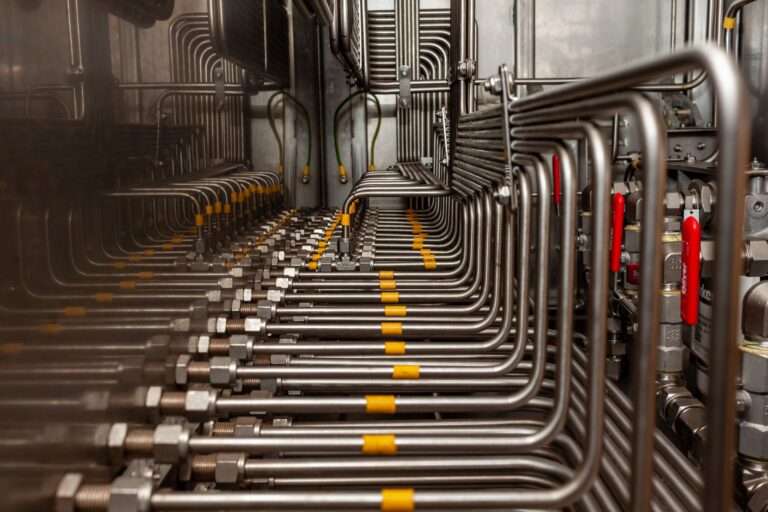
Aerospace nickel alloy and steel components like turbine fuel lines, bypass tubes, and hydraulic assemblies face constant mechanical oscillation, making vibration a primary cause of fatigue failure. These systems require a joining method designed to accommodate cyclic stress while managing assembly weight and supporting structural integrity.
Depending on the joint design and welding process, welded joints may introduce localized heat-affected zones and geometric discontinuities that can contribute to stress concentration under cyclic loading. Properly designed brazed joints offer a joining approach that distributes loads across the assembly. Controlled atmosphere furnaces heat assemblies uniformly to better support long-term vibration resistance.
The Mechanics of Distributing Stress
Brazing relies on capillary action to draw a liquid filler metal into the tight clearance between two closely fitted components. Because the filler metal flows evenly throughout the entire joint area, it creates a highly uniform bond rather than a localized bead.
The defining advantage of a brazed joint under cyclic stress is the formation of a smooth, gradual fillet at the joint transitions. This geometry is designed to distribute operational vibrations evenly across a larger surface area, minimizing the risk of localized fatigue cracking.
Specific High-Vibration Specifics
Certain aerospace assemblies are particularly vulnerable to vibration-induced fatigue. Applying a uniform furnace brazing process to these components helps support component performance under rigorous operational demands:
Tube-to-Fitting Connections
Fluid delivery lines frequently feature thin-walled tubing joined to heavier, machined fittings. Furnace brazing heats both component thicknesses evenly, allowing the filler metal to bridge the gap while minimizing the risk of distortion or burn-through on the thin tubing.
Fuel and Oil Manifolds
Manifolds feature complex geometries with multiple branches and ports that experience high internal pressures. A uniform braze fillet is designed to distribute these multi-directional forces across a broad bonded area rather than concentrating them within a localized fusion zone.
Process Advantages of Continuous Mesh Belt Furnaces
For high-volume manufacturing, consistency across thousands of parts is vital. Franklin Brazing utilizes continuous mesh belt furnaces to deliver repeatable results for complex assemblies through two distinct process advantages:
Simultaneous Multi-Joining Processing
In a continuous mesh belt furnace, the entire assembly is heated uniformly, allowing dozens of intricate joints to be bonded simultaneously. Because the assembly is heated and cooled in a controlled thermal cycle, furnace brazing can reduce localized thermal gradients that are often associated with residual stress formation during welding.
Flux-Free Cleanliness
Our controlled atmosphere process operates entirely without chemical fluxes. This supports an environment where internal passages remain bright, clean, and free of corrosive residues, mitigating a hidden variable that could otherwise compromise joint integrity or contaminate sensitive downstream turbine systems.
Production Capability
Unlike batch vacuum brazing operations optimized for low-volume production, continuous mesh belt furnace brazing can support repeatable, high-volume manufacturing of tube and fitting assemblies while maintaining tight process control.
Meeting Rigorous Manufacturing Specifications
In precision manufacturing, managing process variation is the key to scaling production. Controlled atmosphere brazing allows for tight control over the heating and cooling cycles, supporting predictable interactions between the filler metal and the base alloys.
By utilizing precise furnace parameters, we can reliably process complex tube-to-fitting and manifold assemblies in alignment with customer dimensional and structural specifications. This high degree of repeatability supports consistent process control across high-volume production runs.
Your Partner for Capable Brazing Solutions
Franklin Brazing provides the specialized technical expertise and high-capacity manufacturing capabilities required to solve challenging joining problems. Our team focuses on optimizing the furnace process to support customer requirements for strength, cleanliness, and vibration resistance. We work closely with your engineering team to ensure our controlled atmosphere processes align with your technical prints and material requirements.
Contact Franklin Brazing today to discuss your dissimilar metal project and let our engineering team help you optimize your assembly for joint integrity and reliability.
Disclaimer: Brazing process suitability, joint performance, and final component qualification depend on customer application-specific design, materials, operating conditions, and customer validation requirements. Final component qualification and airworthiness approval remain the responsibility of the customer and applicable regulatory authorities.